Affiliate Program Payout Structures: Maximize Your Commissions
Understanding affiliate program payout structures is crucial for maximizing earnings, as different models like CPS, CPL, and RevShare offer varied commission rates and risk profiles, directly impacting an affiliate's profitability and strategic choices.
Por: Maria Eduarda em 12 de fevereiro de 2026
Última atualização em: 13 de maio de 2026
Advertisements
Understanding affiliate program payout structures is crucial for maximizing earnings, as different models like CPS, CPL, and RevShare offer varied commission rates and risk profiles, directly impacting an affiliate’s profitability and strategic choices.
Navigating the world of affiliate marketing can be incredibly rewarding, but truly understanding how you get paid is the cornerstone of success. If you’re looking to consistently boost your income, grasping the nuances of affiliate program payout structures is not just an advantage—it’s a necessity. This comprehensive guide will break down the various models, helping you strategize for maximum commission rates in today’s competitive digital landscape.
Advertisements
Understanding the Basics of Affiliate Payout Models
Affiliate marketing thrives on performance, meaning you earn a commission for specific actions taken by customers you refer. However, “performance” isn’t a one-size-fits-all concept. Different programs employ diverse payout models,
each with its own set of advantages, disadvantages, and strategic implications for affiliates. Knowing these foundational models is the first step toward optimizing your earnings.
The choice of payout structure by a merchant often reflects their business goals and the value they place on certain customer actions. For instance, a software company might prioritize lead generation, while an e-commerce store
will likely focus on direct sales. Your role as an affiliate is to align your promotional efforts with the payout model that best rewards your specific marketing strengths and audience engagement.
Cost Per Sale (CPS): The most common model
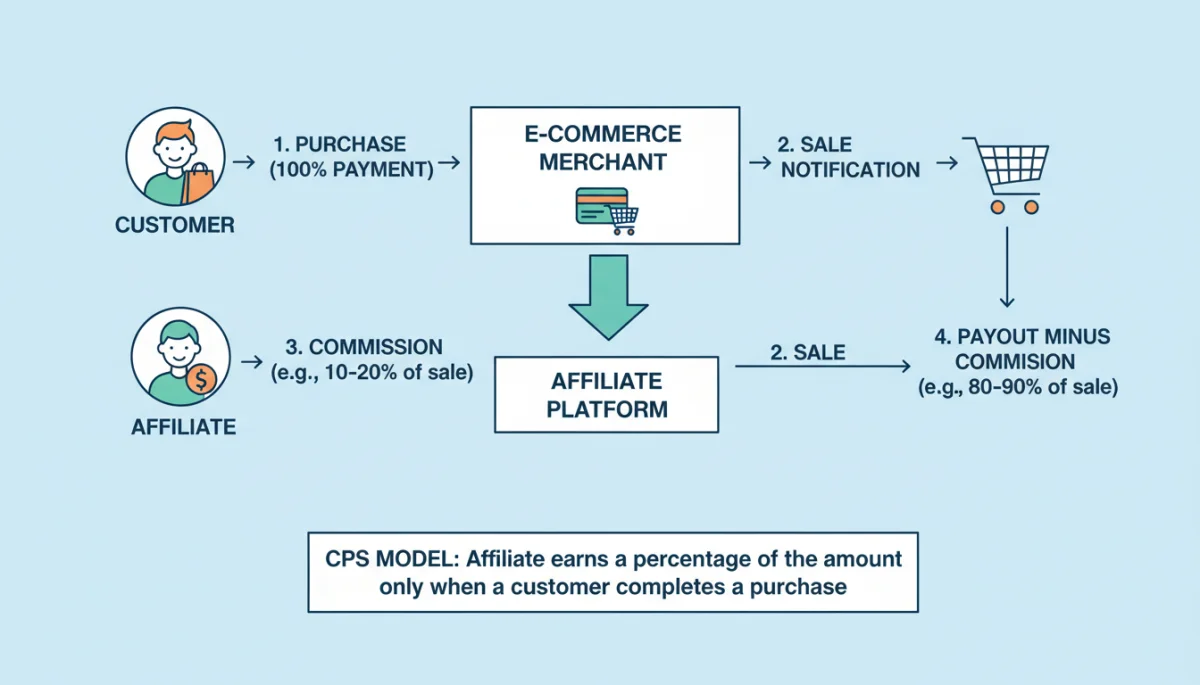
The Cost Per Sale (CPS) model is arguably the most prevalent and straightforward affiliate payout structure. Under CPS, affiliates earn a commission only when a referred customer completes a purchase. This model is favored by
e-commerce businesses because it directly ties affiliate payouts to revenue generation.
Direct Revenue Link: Commissions are a percentage of the sale price or a fixed amount per sale.
High Payout Potential: Offers significant earnings if you can drive consistent sales.
Performance-Based: Rewards affiliates who can convert traffic into paying customers effectively.
Merchant Preference: Low risk for merchants as they only pay for confirmed revenue.
While CPS offers high earning potential, it also demands strong conversion rates from your traffic. Affiliates must focus on attracting high-quality, purchase-intent audiences to succeed with this model. This often involves
detailed product reviews, comparison guides, and direct calls to action that guide the customer through the buying journey.
Cost Per Lead (CPL): Valuing customer data acquisition
Moving beyond direct sales, the Cost Per Lead (CPL) model compensates affiliates for generating qualified leads for a merchant. A lead could be a completed form, a newsletter sign-up, a software download, or even a request for a
quote. The key distinction is that the customer doesn’t necessarily have to make a purchase for the affiliate to earn a commission.
CPL programs are particularly popular in industries where the sales cycle is longer or involves complex products and services, such as financial services, education, and B2B software. Merchants use CPL to build their sales
pipelines and acquire valuable customer data, which can then be nurtured into future sales by their internal teams.
Understanding qualified leads
The definition of a “qualified lead” is paramount in a CPL program. It’s not enough to simply send any traffic; the leads must meet specific criteria set by the merchant. This might include geographic location, income level,
job title, or a genuine interest in the product or service. Generating unqualified leads can lead to rejected commissions and wasted effort.
Focus on Quality: Emphasis on attracting users who fit the merchant’s ideal customer profile.
Lower Barrier to Entry: Easier for users to complete an action (e.g., sign up) than to make a purchase.
Predictable Payouts: Affiliates often receive a fixed payment per valid lead.
Risk for Merchants: Higher risk for merchants if leads don’t convert into sales down the line.
For affiliates, CPL models can offer a more consistent revenue stream compared to CPS, as generating a lead is generally easier than securing a sale. However, the commission per lead is typically lower than per sale, reflecting
the reduced risk for the customer and the earlier stage in the sales funnel. Success in CPL requires effective lead nurturing strategies and careful targeting to ensure lead quality.
The Revenue Share, or RevShare, model is a highly attractive payout structure, particularly in industries with recurring revenue, such as subscriptions, online gaming, and SaaS (Software as a Service). Under RevShare, affiliates
earn a percentage of the revenue generated by their referred customers for the entire lifetime of that customer’s engagement with the merchant.
This model offers significant long-term earning potential, as a single referral can continue to generate income for an affiliate for months or even years. It aligns the affiliate’s interests directly with the merchant’s, as
both benefit from customer retention and increased customer lifetime value (CLV).
The power of recurring commissions
Imagine referring a customer to a streaming service. With a RevShare model, you wouldn’t just get paid for their initial sign-up; you’d earn a percentage of their subscription fee every month they remain a subscriber. This
creates a powerful passive income stream that can grow substantially over time with a strong base of referred customers.
Passive Income: Continual earnings from a single referral.
High CLV Impact: Rewards affiliates for driving valuable, loyal customers.
Strategic Focus: Encourages affiliates to promote products with good retention rates.
Delayed Gratification: Initial payouts might be lower, but long-term growth is significant.
While RevShare models promise substantial long-term gains, they also require patience. Initial commissions might be modest, and it takes time to build up a substantial recurring income. Affiliates focusing on RevShare should
prioritize promoting high-quality products and services that offer excellent customer satisfaction to ensure high retention rates and maximize their ongoing earnings.
Cost Per Click (CPC) and Cost Per Impression (CPM): Traffic-driven models
While less common in traditional affiliate marketing programs today, Cost Per Click (CPC) and Cost Per Impression (CPM) models were foundational in early online advertising and still exist in certain contexts. These models focus
on the very top of the sales funnel, compensating affiliates for driving traffic or simply displaying ads.
CPC pays affiliates a fixed amount each time a user clicks on an advertisement or link. CPM, on the other hand, pays for every thousand impressions (views) an ad receives. These models are typically found in advertising
networks rather than direct affiliate programs, but understanding them provides a broader perspective on performance-based compensation.
When CPC and CPM apply
CPC and CPM are often associated with display advertising, search engine marketing, and content monetization platforms like Google AdSense. In a direct affiliate context, a merchant might use a CPC component for specific brand
awareness campaigns or to drive traffic to informational content, though it’s rare for an entire affiliate program to be solely CPC or CPM based.
High Traffic Volume: Requires enormous traffic to generate significant earnings.
Low Payout Per Action: Individual clicks or impressions yield very small commissions.
Brand Awareness: Primarily used for driving visibility rather than direct conversions.
Easy Action: Users simply need to view or click, not purchase or sign up.
For affiliates, CPC and CPM can generate revenue from any traffic, regardless of conversion intent. However, the extremely low payout rates mean that only websites with massive traffic volumes can make substantial income from
these models. Most modern affiliate programs have moved towards more conversion-focused models like CPS, CPL, or RevShare, as they offer better value for both merchants and affiliates in terms of direct revenue or qualified
leads.
Hybrid payout structures: Combining the best of both worlds
As the affiliate marketing landscape evolves, many programs are moving towards more sophisticated hybrid payout structures. These models combine elements of two or more traditional models, offering affiliates multiple ways to
earn commissions and providing merchants with greater flexibility in their incentive programs. Hybrid models are designed to maximize the effectiveness of affiliate partnerships by rewarding different stages of the customer
journey.
A common hybrid approach might combine a CPL component with a CPS component. For example, an affiliate might earn a smaller commission for every qualified lead generated, and then a larger, additional commission if that lead
subsequently converts into a sale. This dual incentive structure encourages affiliates to focus on both lead quality and eventual conversion.
Examples of hybrid models
Consider a financial product that requires a lengthy application process. A hybrid model might offer a fixed CPL for a completed application and then a percentage of the first year’s fees (RevShare) if the application is
approved and the customer becomes active. This structure rewards the affiliate for both the initial effort of acquiring a lead and the long-term value of a converted customer.
Enhanced Earning Potential: Multiple avenues for commission, diversifying income.
Balanced Incentives: Rewards different stages of the customer funnel, from lead to sale to retention.
Increased Flexibility: Merchants can tailor programs to specific product lines or marketing goals.
Complexity: Can be more intricate to track and understand than single-model programs.
Hybrid models represent a more nuanced approach to affiliate compensation. For affiliates, they can offer greater earning stability and higher overall revenue by capturing value at various touchpoints. However, they also require
a deeper understanding of the program’s terms and conditions, as well as robust tracking to ensure all commissions are accurately attributed. Successful navigation of hybrid models involves careful analysis of the program’s
structure and strategic alignment of promotional efforts to maximize all potential income streams.
Optimizing your strategy for maximum commission rates
Understanding the different affiliate payout structures is merely the first step. To truly maximize your commission rates, you need to develop an optimized strategy that aligns your marketing efforts with the most profitable
payout models and programs. This involves careful research, strategic content creation, audience targeting, and continuous performance analysis.
The goal is not just to drive traffic, but to drive the right kind of traffic that is most likely to complete the desired action, whether it’s a click, a lead, or a sale. This means deeply understanding your audience’s needs and
the merchant’s offerings, then bridging that gap effectively through your content.
Choosing the right programs
Not all affiliate programs are created equal, and not all payout structures will suit every affiliate. Your first step in optimization should be to select programs that align with your niche, audience, and marketing strengths.
If your content excels at generating high-quality leads, focus on CPL programs. If you have an audience with strong purchasing intent, CPS programs might be more lucrative.
Niche Alignment: Select programs that naturally fit your content and audience.
Audience Intent: Match payout models to your audience’s typical behavior (e.g., browsing vs. buying).
Commission Rates: Compare rates across programs and negotiate for better terms if you have strong performance.
Cookie Duration: Longer cookie durations increase your chances of earning a commission.
Furthermore, consider the conversion rates of the merchant’s landing pages and products. Even with a high commission rate, a poor-converting offer won’t yield significant income. Look for programs with a proven track record of
converting referred traffic into desired actions. Test different programs and track your performance diligently to identify what works best for your specific audience and promotional methods.
Advanced strategies for boosting affiliate earnings
Beyond simply choosing the right payout structures, several advanced strategies can significantly boost your overall affiliate earnings. These involve a deeper dive into data analysis, negotiation tactics, and leveraging
technology to improve your performance. Successful affiliates are not just marketers; they are also analysts and strategists.
One critical strategy is to regularly analyze your performance metrics. This includes conversion rates, earnings per click (EPC), and customer lifetime value (CLV) where applicable. By understanding these numbers, you can
identify underperforming campaigns, optimize your content, and reallocate your resources to more profitable ventures. Data-driven decisions are key to sustained growth.
Negotiating higher commissions
Many affiliates don’t realize that commission rates are often negotiable, especially once you’ve proven your value. If you consistently drive high-quality traffic and generate significant sales or leads for a merchant, don’t
hesitate to approach them to discuss a higher commission rate. Merchants are often willing to reward top performers to retain their partnership.
Prove Your Value: Show concrete data of your performance and impact.
Long-term Relationships: Build strong, trust-based relationships with affiliate managers.
Exclusive Deals: Seek exclusive offers or higher commission tiers for your audience.
Stay Informed: Be aware of industry standards and competitor offers to strengthen your position.
Another advanced tactic involves diversifying your income streams by promoting a variety of products and services across different payout models. This reduces your reliance on a single program or merchant and provides a buffer
against potential changes in commission rates or program terms. Ultimately, continuous learning, adaptation, and a proactive approach to optimization are what separate successful affiliates from the rest.
Payout Model
Brief Description
Cost Per Sale (CPS)
Affiliates earn a commission only when a referred customer completes a purchase.
Cost Per Lead (CPL)
Affiliates are paid for generating qualified leads (e.g., sign-ups, form completions).
Revenue Share (RevShare)
Affiliates earn a percentage of a customer’s revenue for their entire lifetime.
Hybrid Models
Combination of two or more payout structures to reward various customer actions.
Frequently asked questions about affiliate payouts
What is the most profitable affiliate payout structure?▼
The most profitable structure depends on your niche and traffic quality. Cost Per Sale (CPS) offers high commissions per conversion, while Revenue Share (RevShare) provides long-term passive income. Cost Per Lead (CPL) can be consistent for lead-focused content. Analyzing your audience’s behavior helps determine the best fit.
How can I negotiate higher commission rates with merchants?▼
To negotiate higher rates, demonstrate your value with solid performance data, such as high conversion rates or significant sales volume. Build a strong relationship with your affiliate manager and highlight your unique promotional capabilities. Proving your consistent ability to drive quality traffic is key to securing better terms.
What are hybrid affiliate payout models and their benefits?▼
Hybrid models combine elements of different structures, like CPL plus CPS. Benefits include diversified earning opportunities, rewarding affiliates at various stages of the customer journey, and increased flexibility for merchants to incentivize specific actions. They can lead to more stable and higher overall earnings for affiliates.
Why are Cost Per Click (CPC) and Cost Per Impression (CPM) less common in affiliate programs?▼
CPC and CPM models offer very low payouts per action, requiring extremely high traffic volumes to be profitable. They are primarily for brand awareness rather than direct conversions. Modern affiliate programs prioritize models like CPS, CPL, and RevShare, which directly link affiliate efforts to revenue or valuable leads for merchants.
How does cookie duration impact my affiliate earnings?▼
Cookie duration determines how long after a click your referral can still be attributed to you. A longer cookie duration means you have a greater window for the customer to make a purchase or take a desired action, increasing your chances of earning a commission, even if the conversion isn’t immediate.
Conclusion
Mastering the various affiliate program payout structures is fundamental for any affiliate looking to thrive in the current market. From the direct revenue generation of CPS to the long-term passive income of RevShare and the lead acquisition focus of CPL, each model presents unique
opportunities and challenges. By carefully selecting programs that align with your content and audience, continuously analyzing your performance data, and even negotiating for better terms, you can significantly enhance your
commission rates. The key to maximizing your earnings lies in a strategic, informed approach that leverages the intricacies of how you get paid, transforming your efforts into a truly profitable venture.
A journalism student and passionate about communication, she has been working as a content intern for 1 year and 3 months, producing creative and informative texts about decoration and construction. With an eye for detail and a focus on the reader, she writes with ease and clarity to help the public make more informed decisions in their daily lives.